Understanding Dash : The Ultimate Guide to the Original ‘Digital Cash’ Cryptocurrency
In the rapidly evolving world of blockchain and cryptocurrency, hundreds of projects launch every year promising to revolutionize global finance. While many fade into obscurity, a select few pioneers have stood the test of time by consistently delivering real-world utility. One such asset is Dash.
Derived from the phrase “Digital Cash,” Dash was engineered with a singular, clear-cut objective: to create a decentralized, global payment network that mimics the convenience of physical cash while leveraging the security and borderless nature of blockchain technology.
Whether you are a crypto enthusiast, an investor, or a web developer looking to integrate digital payments, this comprehensive guide will unpack everything you need to know about Dash—from its fascinating history and unique two-tier architecture to its market-leading features and real-world adoption.
The History and Rebranding Evolution of Dash
The story of Dash began in January 2014, making it one of the oldest active altcoins in the cryptocurrency space. The project was founded by software developer Evan Duffield, who noticed fundamental limitations in Bitcoin’s architecture—specifically regarding transaction speeds and user privacy.
When the network first launched, it was called XCoin (XCO). Within just a few weeks, the development team rebranded it to Darkcoin. During this phase, the project focused heavily on transaction anonymity and privacy, addressing a growing demand for untraceable digital transactions that Bitcoin’s public ledger could not fully provide.
However, the team quickly realized that a strict focus on “dark” privacy created a negative stigma, potentially hindering mainstream retail adoption and regulatory compliance. To pivot toward becoming a mass-market payment solution, the project underwent a final, major rebranding on March 26, 2015, officially becoming Dash.
This rebranding marked a monumental shift in philosophy: Dash was no longer just a “privacy coin”—it was a scalable, ultra-fast, user-friendly digital currency built for everyday commercial transactions.
The Two-Tier Network Architecture: How Dash Invents Scalability
Most traditional blockchains, including Bitcoin and Litecoin, rely on a single-tier network where all tasks are handled by a single type of participant: the miners. Dash completely disrupted this model by introducing a revolutionary Two-Tier Network Architecture.
Layer 1: The Miners (Proof-of-Work)
The first layer consists of traditional miners who secure the blockchain using a consensus mechanism called X11. Designed by Evan Duffield, X11 is a chained hashing algorithm that utilizes 11 different cryptographic functions. This multi-layered approach was originally created to prevent the centralization of mining by custom ASIC (Application-Specific Integrated Circuit) chips, keeping mining accessible to standard GPU hardware for longer. Today, while X11 ASICs do exist, the algorithm still provides world-class cryptographic security. Miners on this layer are responsible for validating basic transactions and creating new blocks.
Layer 2: The Masternodes
The second layer is what truly sets Dash apart from its competitors. This layer is powered by specialized, high-performance servers called Masternodes. To run a Masternode, an operator must lock up a collateral of exactly 1,000 DASH coins.
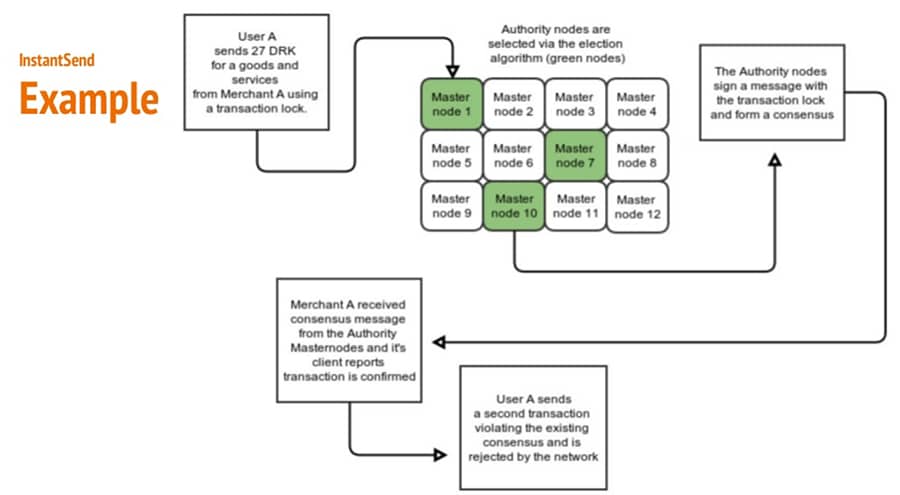
This collateral requirement serves two vital purposes: it prevents “Sybil attacks” (where a malicious actor creates thousands of fake nodes to overpower the network), and it ensures that Masternode operators have a strong financial incentive to maintain the honesty, uptime, and health of the ecosystem. In exchange for hosting full copies of the blockchain and providing advanced network services, Masternode operators earn a significant portion of the block rewards.
Core Technical Features of Dash
Thanks to its powerful Masternode layer, Dash can execute advanced features that single-tier blockchains simply cannot support natively.
1. InstantSend (Instant Payments)
One of Bitcoin’s greatest hurdles for retail use is its block confirmation time, which takes an average of 10 minutes (and often hours during network congestion). Nobody wants to wait 10 minutes at a coffee shop counter for a transaction to clear.
Dash solves this with InstantSend. When an InstantSend transaction is initiated, a randomly selected quorum of Masternodes locks the transaction inputs in under two seconds. Once locked, the funds cannot be double-spent, and the transaction is instantly recognized as fully cleared by the recipient’s wallet, even before it is officially packaged into a block by miners.
2. PrivateSend (Financial Anonymity)
While Dash prioritizes mainstream utility, it maintains a strong commitment to user privacy. PrivateSend is an optional, built-in mixing service based on the CoinJoin protocol.
When a user activates PrivateSend, the wallet breaks down the transaction amount into standard denominations (e.g., 0.1 DASH, 1 DASH, 10 DASH) and mixes them with the funds of other users through multiple Masternodes. This effectively breaks the visible transactional chain on the public blockchain, giving users the same financial privacy they enjoy when spending physical paper cash.
3. ChainLocks (Unmatched Security)
In Proof-of-Work systems, smaller networks are vulnerable to a “51% attack,” where an entity leases enough computing power to rewrite the blockchain’s history. Dash mitigates this risk entirely through ChainLocks.
For every new block mined, a Masternode quorum evaluates and signs off on it. Once a block is signed by the quorum, it is permanently locked into the ledger. No alternative chain can overwrite a locked block, regardless of how much hashing power an attacker possesses. This makes Dash mathematically immune to 51% reorganization attacks.
The Dash DAO: Self-Funding and Decentralized Governance
Dash is widely recognized as one of the world’s very first successful Decentralized Autonomous Organizations (DAOs). Unlike Bitcoin, which relies heavily on third-party donations, corporate sponsorships, or foundation grants to fund development, Dash has a built-in, self-sustaining financial model.
Every time a new block is successfully added to the Dash blockchain, the block reward is mathematically split by the protocol into three distinct categories:
- 45% goes to the Miners: Rewarding them for computational security.
- 45% goes to the Masternodes: Rewarding them for hosting advanced services like InstantSend and PrivateSend.
- 10% goes to the Network Treasury: Deposited into a decentralized pool meant to fund the future growth of the ecosystem.
Anyone in the world can submit a proposal to the Dash network—whether it is for core software development, marketing campaigns, merchant integration, or community events. Masternode operators then cast their votes on these proposals. If a proposal gains enough net positive votes, the blockchain automatically generates the requested funds directly from the 10% Treasury during the monthly “superblock” phase and pays the creator. This self-funding mechanism ensures that Dash remains independent and continuously evolving.
Head-to-Head: Dash vs. Bitcoin
To better understand Dash’s market positioning, it helps to look at a direct structural comparison with Bitcoin:
| Architectural Feature | Dash (DASH) | Bitcoin (BTC) |
|---|---|---|
| Primary Use Case | Everyday digital cash & retail payments | Digital gold & long-term store of value |
| Network Structure | Two-Tier (Miners + Masternodes) | Single-Tier (Miners only) |
| Transaction Speed | Under 2 seconds (via InstantSend) | 10 minutes to several hours |
| Transaction Fees | Micro-cents (fraction of a penny) | Variable (can range from $1 to $50+) |
| Security vs 51% Attacks | Absolute protection via ChainLocks | Rely purely on total hash rate dominance |
| Project Funding | Built-in 10% Blockchain Treasury | External sponsorships & volunteer grants |
| Maximum Supply | ~18.9 Million DASH | 21 Million BTC |
Real-World Adoption and Hyperinflation Relief
While many cryptocurrencies exist purely as speculative assets on trading exchanges, Dash has carved out a massive footprint as a functional currency in developing economies.
The most prominent example of this is in Latin America, specifically Venezuela. Faced with catastrophic hyperinflation where the local fiat currency (the Bolivar) lost its value daily, citizens and merchants desperately needed an alternative.
Dash stepped in with localized marketing and merchant onboarding initiatives. Because Dash transactions cost fractions of a cent and settle instantly, thousands of Venezuelan businesses—ranging from local grocery stores and pharmacies to multinational fast-food chains like Subway and Burger King—began accepting Dash. It proved that crypto could successfully serve as a stable, day-to-day medium of exchange when traditional fiat systems collapse.
Furthermore, applications like DashDirect allow users in developed countries to spend their Dash seamlessly at hundreds of major retail brands, bridging the gap between crypto and traditional commerce.
The Pros and Cons of Dash
To provide a balanced view for your readers, here is an objective breakdown of Dash’s current advantages and challenges:
The Pros:
- True Retail Viability: The speed of InstantSend makes it perfectly suited for physical point-of-sale checkouts.
- Financial Autonomy: The DAO Treasury model guarantees continuous innovation without relying on external corporate influence.
- Robust Security: The combination of X11 hashing and ChainLocks creates an incredibly secure environment.
- User-Centric Innovations: Continuous updates focus on removing technical barriers, such as replacing complex cryptographic addresses with readable usernames (Dash Platform).
The Cons:
- Masternode Centralization Risk: Because hosting a Masternode requires 1,000 DASH, the governing voting power is naturally concentrated among wealthy holders or large staking pools.
- Intense Market Competition: Dash faces immense pressure from modern Layer-1 smart contract platforms, decentralized payment applications, and fiat-backed stablecoins (like USDT or USDC).
- Regulatory Friction: Even though privacy features are completely optional, some global exchanges have faced regulatory pressure regarding coins with mixing capabilities, occasionally impacting Dash’s liquidity in specific regions.
The Road Ahead: What is Dash Platform?
Dash is not resting on its laurels as a simple transactional asset. The network’s current evolutionary phase centers around Dash Platform, a technology stack designed to turn the Dash network into a cloud-like decentralized application (DApp) platform.
Instead of copying complex cryptographic wallet addresses (e.g., Xb7...8v9), Dash Platform introduces a native decentralized identity system. Users can register unique usernames, create friend lists, and send payments just like they would on Venmo or PayPal, but with all the underlying benefits of an immutable, decentralized blockchain.
Conclusion
Dash remains a masterclass in how a cryptocurrency can align technical innovation with real-world practicality. By splitting its network architecture into a balanced system of miners and incentivized Masternodes, it successfully conquered the issues of transaction speed, scalability, and self-funding that continue to plague other legacy blockchains.
While the broader crypto market fluctuates based on hype and speculation, Dash continues to quietly execute its original mission: delivering fast, private, and secure digital cash to anyone, anywhere in the world.
As the cryptocurrency market continues to evolve, understanding individual assets is crucial for every investor. If you are interested in exploring other high-potential assets, we recommend reading our recent report: DGB Analysis 2026: Future Growth & Potential.